Getting visits, not calls
Traffic exists. The problem is the first page does not tell a buyer who has never heard of you why you are the right choice. They land, scan, and leave.
WHAT WE BUILD // FRONT DOOR
The Buyer Entry System turns the homepage, service paths, proof, and first calls to action into a clear front door for the right visitor. They should know what you do, who you help, why you are credible, and what to do next without hunting.
WHAT IT IS
"The Buyer Entry System is Smart Website Pro's front-door structure for the Digital Home. It organizes the homepage, primary service paths, proof, and first calls to action so a buyer can understand the business quickly. The goal is to reduce confusion before it becomes a lost visit."
Most weak websites do not fail because they are ugly. They fail because the first page answers the wrong question first. Buyers need relevance, credibility, and a clear next step before they decide to keep moving.
WHO THIS IS FOR
Getting visits, not calls
Traffic exists. The problem is the first page does not tell a buyer who has never heard of you why you are the right choice. They land, scan, and leave.
Explaining the business on every call
The first few minutes of every call are the same: what you do, how you work, why you are different. That is the website's job before the buyer ever picks up the phone.
Ranking well but converting poorly
The traffic is coming from the right searches. The page it lands on does not close the gap. Good visibility, weak entry. The front door needs to answer faster.
Good branding, low performance
The logo is sharp, the colors are consistent, and the photography is real. But the site still reads like a brochure. Good design without message structure still loses buyers.
HOW IT WORKS
We review the homepage, primary service paths, proof, and first-contact points. The question is simple: what does a new buyer understand before they decide to stay or leave?
The page has to answer buyer questions in sequence: what you do, who it is for, why you are credible, and what happens next. Most weak sites skip at least one.
Major services need clear paths, not a buried service list. Each path should match the problem the buyer has, the proof they need, and the next action they can take.
Reviews, credentials, photos, and examples should sit near the claim they support. Proof buried on a separate page does not help when the buyer is deciding right now.
Calls, forms, chat, estimate paths, and Blueprint paths should appear where momentum is highest. The buyer should never have to hunt for the next move.
WHAT GETS CLARIFIED
The first screen explains what the business does, who it helps, and why the right visitor should keep reading.
Each core service gets a path built around the buyer's problem, not a generic paragraph under a services heading.
Reviews, photos, credentials, guarantees, and process details appear where the buyer's doubt is strongest.
The page gives one obvious next step at the right moment: call, form, chat, estimate, booking, or Blueprint.
Headings, openings, and page structure make it clear what the business does and which buyer question the page answers.
Homepage, services, proof, FAQs, and capture pages connect so the buyer can move without starting over.
SCOPE // WHAT SHAPES THE PLAN
Pricing is not published here because scope depends on page condition, service count, proof quality, CTA paths, and how much structure already exists. The Digital Home Blueprint shows what needs to change before the front door is rebuilt.
Start Your BlueprintSome sites need a hierarchy pass. Others need the homepage, primary service pages, proof, and contact paths rebuilt together.
A single-service company has a simpler entry system than a contractor with emergency, repair, replacement, maintenance, and financing paths.
Reviews, photos, credentials, project examples, and process details shape how much proof can be placed near the buyer's doubts.
A site with only a phone number is different from one that also needs chat, forms, estimates, booking, and Digital Home Blueprint paths.
SIGNS YOU NEED IT
If a buyer has to decode the homepage, hunt for services, or guess whether you handle their problem, the site is leaking. The Buyer Entry System gives the front door a job before deeper rooms, local signals, and follow-up paths take over.
QUESTIONS ABOUT THE BUYER ENTRY SYSTEM
The Buyer Entry System is Smart Website Pro's front-door structure for the Digital Home. It organizes the homepage, primary service paths, proof, and first calls to action so a new visitor can quickly understand what the business does, who it helps, why it is credible, and what to do next.
A redesign usually focuses on how the site looks. The Buyer Entry System focuses on what the first pages communicate. A site can look polished and still lose buyers if the message is vague, proof is misplaced, or the next step is unclear.
Not always. Some homepages have the right raw material in the wrong order. Others are missing proof, service clarity, or a meaningful first action. The Digital Home Blueprint shows what is working before anything changes.
Message hierarchy is the order in which the page answers buyer questions. First: what do you do? Second: who is it for? Third: why should I believe you? Fourth: what do I do next? Most weak homepages answer those questions out of order or skip them.
Buyers do not all arrive with the same problem. Emergency repair, replacement research, maintenance, financing, and project planning need different pages or sections. Service paths help the right visitor find the right context faster.
Proof should sit near the doubt. If a buyer is deciding whether you handle a specific job, the review, photo, credential, or example should appear near that service context. A testimonials page alone is not enough.
Yes, or at least in parallel. Sending more traffic to a front door that does not explain the business just increases the number of people who leave. The entry system gives visibility work a page worth sending buyers to.
Scope depends on the homepage condition, number of primary services, proof quality, existing page structure, and how many next steps need to be wired. The Digital Home Blueprint is the starting point because it shows the entry gaps before the plan is finalized.
Yes. The Buyer Entry System works inside the visual direction that already exists when the brand is working. The goal is to fix message, structure, proof, and path clarity. If a design choice blocks the message, it gets flagged.
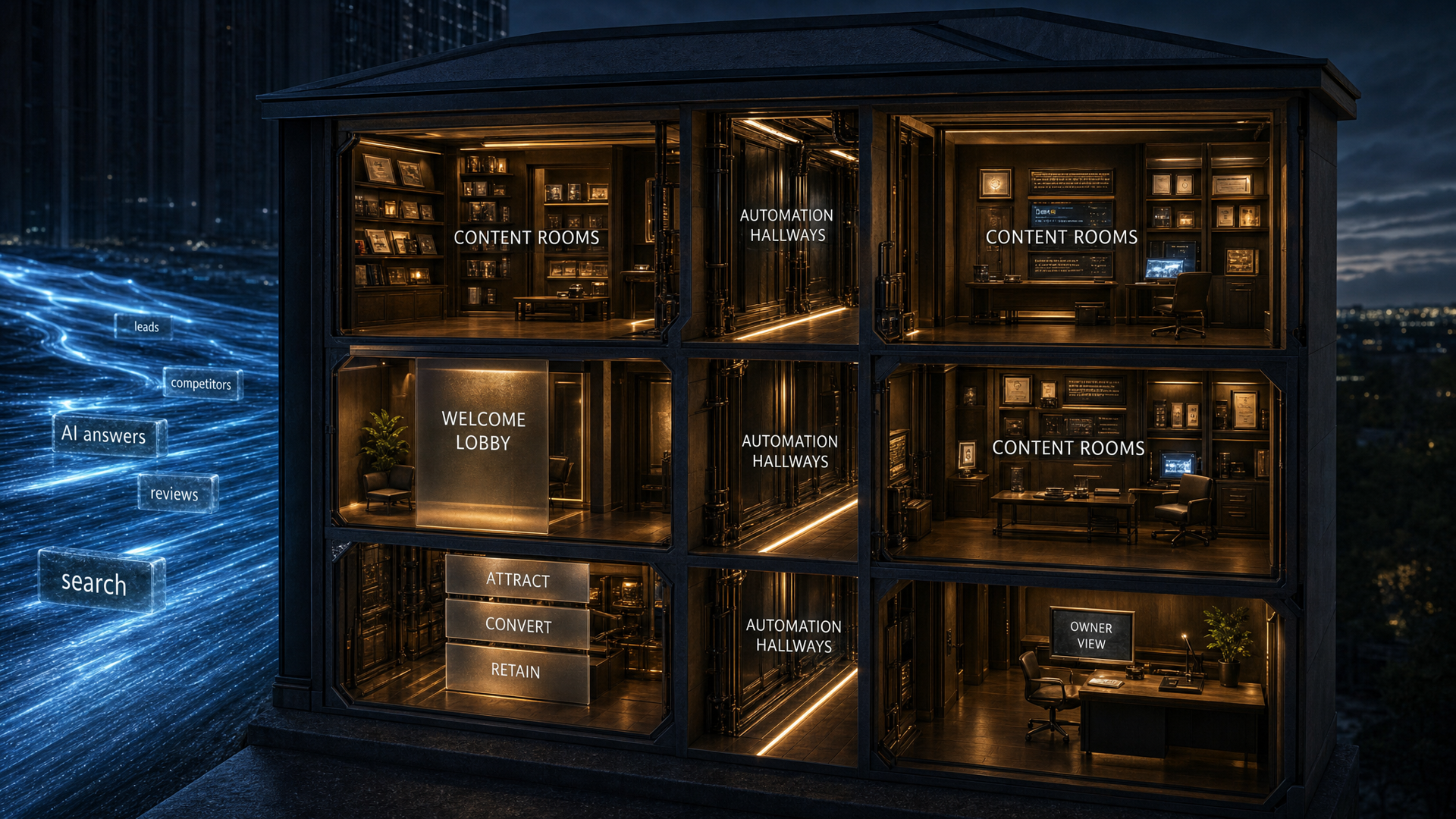
The Buyer Entry System is the front door. The next step is usually the broader Digital Home structure: service rooms, answer depth, local signals, content authority, capture paths, and follow-up hallways.
NEXT ROOMS // KEEP MOVING
See how the front door connects to content rooms, local signals, automation hallways, and conversion paths.
Open this pathTurn service answers, proof, FAQs, and local context into pages buyers and search systems can understand.
Open this pathConnect first actions to routing, reminders, booking, notifications, and follow-up after the buyer raises their hand.
Open this pathDIGITAL HOME BLUEPRINT // READY
The blueprint reviews your services, proof, buyer questions, lead paths and follow-up structure, then shows what should be fixed or built first.